
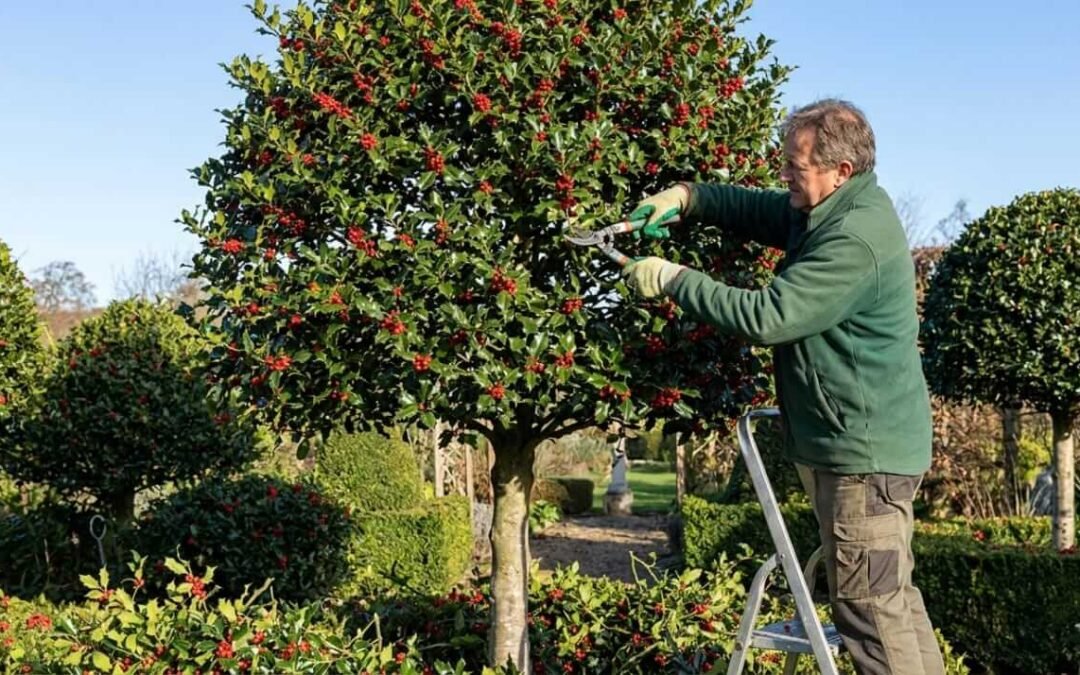
Holly trees have earned their place as one of the most recognizable and versatile landscape plants in North America. With their glossy evergreen foliage, distinctive red berries, and ability to thrive in a variety of conditions, hollies provide year-round structure and visual interest in residential and commercial landscapes alike.
Yet despite their reputation for toughness, many homeowners are uncertain about one essential aspect of holly care: pruning.
Questions arise every year. When is the best time to prune a holly tree? How much can be removed safely? Will pruning reduce berry production? Should hollies be sheared into formal shapes or allowed to retain their natural form?
The answers depend on the type of holly, the condition of the plant, and the goals of the homeowner. Understanding how hollies respond to pruning can mean the difference between a dense, healthy specimen and a shrub that struggles to recover from improper cuts.
This guide explores the principles of pruning holly trees, including timing, techniques, common mistakes, and professional recommendations for maintaining healthy growth over the long term.
Understanding How Holly Trees Grow
Before making the first cut, it is important to understand how hollies develop.
Unlike many fast-growing ornamental shrubs, hollies tend to produce dense branching structures that respond well to selective pruning. New growth emerges from dormant buds located along branches and stems. When a branch is cut back, the plant redirects energy into these buds, encouraging new shoots and fuller growth.
This characteristic makes hollies highly adaptable. They can be maintained as natural specimens, formal hedges, privacy screens, or decorative topiary forms.
However, their ability to recover from pruning often leads homeowners to believe that they can be cut indiscriminately. While hollies are resilient, proper technique remains essential for preserving structure, health, and appearance.
Why Pruning Holly Trees Matters
Pruning serves several important purposes beyond aesthetics.
A well-executed pruning program helps:
- Remove dead or damaged wood
- Improve air circulation within the canopy
- Encourage healthy new growth
- Maintain a desirable size and shape
- Reduce the risk of storm damage
- Promote long-term structural integrity
Without periodic pruning, hollies can become dense, overgrown, and difficult to manage. Branches may begin crossing or rubbing against one another, creating wounds that invite disease and insect activity.
Over time, neglected hollies often develop thick outer growth while becoming sparse and shaded inside. Strategic pruning helps restore balance and vitality throughout the entire plant.
The Best Time to Prune Holly Trees
Timing is one of the most debated aspects of holly pruning.
For most holly species, major pruning is best performed while the plant is dormant during late winter or very early spring before new growth begins. During dormancy, energy reserves remain stored within the plant, allowing it to recover efficiently once active growth resumes.
Dormant-season pruning offers several advantages:
- Better visibility of branch structure
- Reduced stress on the plant
- Faster healing during spring growth
- Lower risk of pest and disease issues
However, evergreen hollies may also benefit from light maintenance pruning during early summer. This timing allows homeowners to refine shape and remove unwanted growth while minimizing the risk of frost damage to tender new shoots.
The ideal timing ultimately depends on climate, species, and pruning objectives.
Understanding Berry Production
One of the most common concerns homeowners have involves berry loss.
Female holly plants produce the bright red berries that make hollies so attractive during fall and winter. Those berries develop from flowers produced earlier in the growing season.
When pruning removes flower buds, berry production is reduced.
Homeowners who value ornamental berries should consider this before making extensive cuts. Heavy pruning immediately before flowering may significantly decrease the number of berries produced during the following season.
For many gardeners, maintaining a balance between appearance and berry production becomes an important consideration in their pruning strategy.
Formal Pruning vs. Natural Pruning
Hollies are remarkably versatile and can be maintained using two distinct approaches.
Formal Pruning
Formal pruning emphasizes structure and symmetry.
Examples include:
- Hedges
- Privacy screens
- Geometric shapes
- Topiary forms
This approach requires regular maintenance to preserve clean lines and consistent growth patterns.
Formal pruning works particularly well for landscapes that emphasize order and architectural design.
Natural Pruning
Natural pruning focuses on enhancing the plant’s inherent growth habit.
Rather than creating rigid shapes, natural pruning involves:
- Removing selected branches
- Improving balance
- Encouraging healthy development
Many arborists and horticultural professionals prefer this method because it preserves the plant’s character while reducing long-term maintenance requirements.
Natural pruning often produces healthier, more attractive specimens over time.
Step-by-Step Holly Pruning Process
Professional pruning follows a deliberate sequence.
Step 1: Inspect the Plant
Begin by evaluating the overall condition of the holly.
Look for:
- Dead branches
- Diseased wood
- Storm damage
- Structural defects
This assessment helps identify priorities before any cuts are made.
Step 2: Remove Dead, Diseased, and Damaged Wood
These branches should always be removed first.
Removing compromised wood:
- Improves appearance
- Reduces disease risk
- Encourages healthy growth
Cuts should be made back to healthy tissue whenever possible.
Step 3: Eliminate Crossing Branches
Branches that rub against one another can create wounds that become entry points for insects and pathogens.
Removing one of the competing branches helps improve airflow and structural integrity.
Step 4: Thin the Interior
One of the most overlooked techniques in holly pruning involves selective interior thinning.
Instead of focusing exclusively on the outer shell, remove selected interior branches to allow sunlight and air to penetrate deeper into the canopy.
Benefits include:
- Improved interior foliage development
- Better air circulation
- Reduced risk of fungal problems
- Fuller growth throughout the plant
Step 5: Shape Carefully
Once structural pruning is complete, shape the plant as desired.
Always step back periodically to evaluate symmetry and balance.
Many pruning mistakes occur because homeowners focus too closely on individual cuts rather than the overall form.
Hand Pruning vs. Shearing
Although hedge shears are commonly used on hollies, hand pruning often produces superior results.
Hand Pruning
Advantages include:
- More natural appearance
- Better branch selection
- Healthier long-term growth
- Reduced risk of dense outer shells
Shearing
While shearing creates a uniform appearance quickly, repeated shearing can encourage excessive outer growth while shading the interior.
Over time, this may produce a hollow plant with foliage concentrated only on the exterior surface.
For specimen hollies and ornamental plantings, selective hand pruning generally delivers better results.
Renovation Pruning for Overgrown Hollies
Sometimes hollies are neglected for years and become far larger than intended.
Fortunately, hollies tolerate renovation pruning exceptionally well.
Large, overgrown specimens can often be reduced significantly and still recover successfully.
However, many professionals recommend gradual reduction when possible.
Rather than removing excessive growth in a single season:
- Reduce size incrementally
- Allow recovery between pruning cycles
- Continue shaping over multiple years
This approach preserves appearance while minimizing stress.
Common Holly Pruning Mistakes
Even experienced gardeners occasionally make mistakes.
The most common include:
Pruning at the Wrong Time
Late-season pruning can stimulate new growth vulnerable to frost damage.
Removing Too Much at Once
Although hollies tolerate heavy pruning, excessive removal may temporarily weaken the plant.
Ignoring Interior Growth
Focusing only on exterior shaping often leads to sparse interiors.
Using Dull Tools
Poor cuts heal more slowly and may increase susceptibility to disease.
Forcing Artificial Shapes
Shapes that conflict with the plant’s natural growth habit typically require more maintenance and produce less attractive results over time.
Tools for Pruning Holly Trees
Successful pruning begins with proper equipment.
Recommended tools include:
- Hand pruners
- Bypass loppers
- Pole pruners
- Pruning saws
All tools should be:
- Sharp
- Clean
- Well-maintained
Sharp tools create cleaner cuts that heal more efficiently.
When to Call a Professional
While many holly pruning tasks can be handled by homeowners, professional assistance may be appropriate when:
- Trees exceed safe ladder height
- Branches extend over structures
- Electrical lines are nearby
- Extensive renovation pruning is required
- Disease or structural instability is suspected
Professionals can evaluate risks and ensure pruning is performed safely and effectively.
Final Thoughts
Pruning holly trees is not simply about controlling size. It is about guiding growth, improving health, and preserving the qualities that make hollies valuable landscape plants.
Whether maintaining a formal hedge, encouraging berry production, or restoring an overgrown specimen, success depends on understanding how hollies respond to pruning and applying techniques that support long-term vitality.
When approached thoughtfully, pruning becomes more than maintenance—it becomes an investment in the future health, beauty, and resilience of the landscape.